How to Implement Cobot Automation in Your Business Operations?
Cobot automation is revolutionizing the manufacturing industry. It blends human skills with robotic efficiency. This synergy allows businesses to optimize their operations and boost productivity.
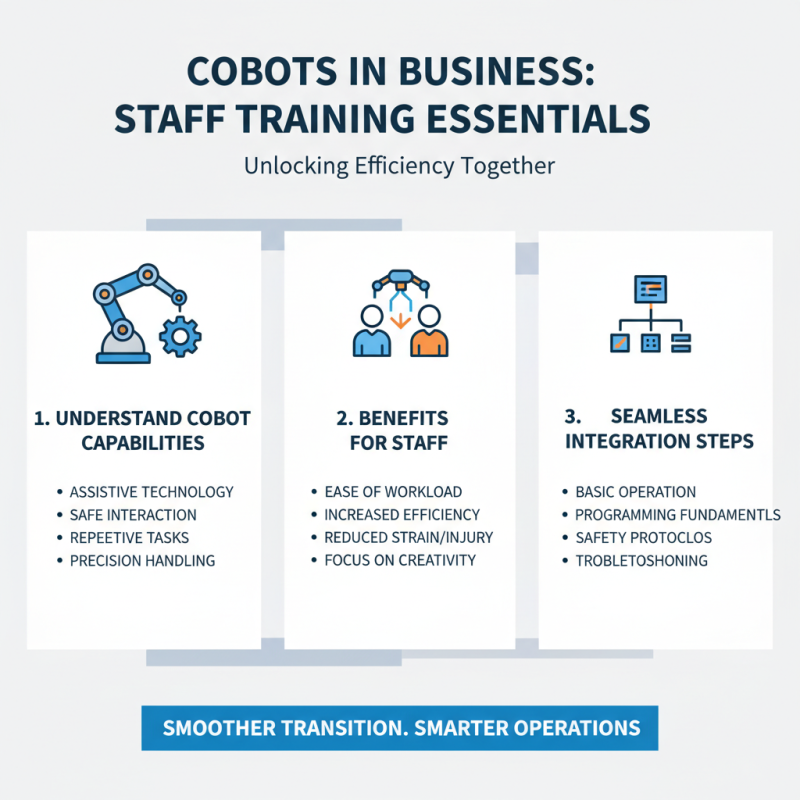
Implementing cobot automation can seem daunting. Many companies face challenges like employee resistance and high initial costs. It’s crucial to address these concerns openly. Training your staff and integrating cobots gradually can ease the transition. For instance, a company may start by automating simple tasks. This allows employees to adapt without feeling overwhelmed.
Moreover, adapting cobot automation requires continuous reflection. It's important to assess the impact on your team. Are they more productive? Do they feel secure in their roles? Addressing these questions fosters a positive environment. Embracing this technology can yield significant rewards, but it’s not without its hurdles. Careful planning and sensitivity to employee concerns are essential for success.

Understanding Cobot Automation and Its Benefits
Cobot automation, or collaborative robotics, offers significant advantages to businesses. These robots work side by side with human employees. They enhance productivity and safety without completely replacing human roles. Imagine a manufacturing floor where cobots assist with repetitive tasks. This allows workers to focus on more complex activities. The result is a more efficient workflow and less employee burnout.
One clear benefit is precision. Cobots can perform tasks with consistent accuracy. This reduces errors and waste in production lines. Furthermore, they are easy to program. Some cobots require minimal training to operate. However, this ease of use might lead to over-reliance. Companies could underestimate the importance of human intuition and oversight.
Cost is another factor to consider. Cobots can lower operational expenses in the long run. However, the initial investment may be significant. Businesses must assess their specific needs. Investment without clear planning can result in setbacks. Adopting cobot automation is not a one-size-fits-all approach; it demands thoughtful evaluation and adjustments over time.
Cobot Automation Implementation Benefits
Identifying Suitable Applications for Cobot Integration
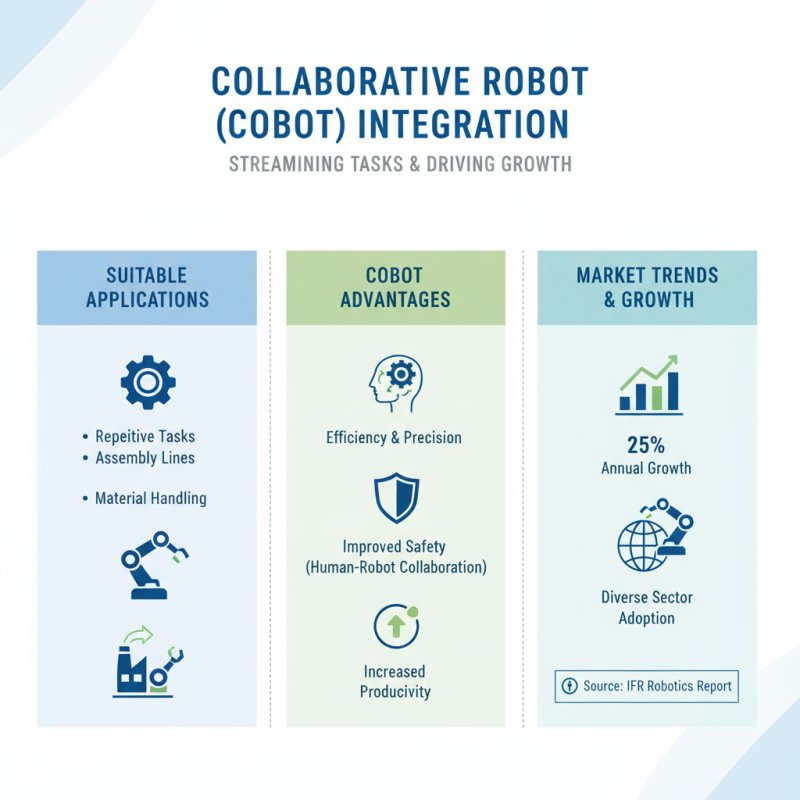
Identifying suitable applications for collaborative robot (cobot) integration requires careful evaluation. Cobots excel in repetitive tasks. They can assist in assembly lines and material handling. According to a recent report by the International Federation of Robotics, cobot sales are expected to grow by 25% annually. This indicates a strong market trend for automation in diverse sectors.
Focus on tasks that improve efficiency. For instance, cobots can take over tedious packing duties. This allows human workers to focus on critical thinking tasks. Data from McKinsey highlights that automation can enhance productivity by up to 60%. However, companies must assess integration challenges. Employee training and workflow re-design are crucial. Not all operations are suitable for cobot deployment. Underestimating this can lead to friction in the workplace.
Additionally, integrating cobots into quality control can be beneficial. They can reduce errors in inspections. However, reliance on automation for quality assurance can lead to complacency. The balance between human oversight and machine efficiency remains delicate. Companies should continuously evaluate their approach and gather feedback to refine the integration process. The goal is to find harmony between human workers and robotic systems.
Evaluating the Required Technology and Infrastructure
Implementing cobot automation requires careful consideration of the necessary technology and infrastructure. Start by assessing your current operational setup. Examine existing equipment and processes. Identify areas where cobots can fit in. This evaluation is crucial. It helps in deciding what additional resources are needed.
In terms of infrastructure, ensure your workspace can accommodate cobots. Space is essential for safe operation. Safety measures must be in place to protect human workers. This might involve physical barriers or safety sensors. Connectivity is another vital aspect. Cobots need robust networks to communicate seamlessly with other systems.
Reflect on your team's capabilities as well. Not all staff may be ready for this transition. Training sessions could be required. Addressing skill gaps is important. Regular feedback from employees can guide refinements in operation. Adaptation will take time. Embrace the learning curve as your team adjusts to this new technology.
How to Implement Cobot Automation in Your Business Operations? - Evaluating the Required Technology and Infrastructure
| Aspect |
Description |
Technology Requirements |
Infrastructure Needs |
| Cobot Selection |
Choosing the right collaborative robot that fits your application. |
Payload capacity, reach, and programming interface. |
Space for cobot operation and safety barriers if needed. |
| Integration with Existing Systems |
Ensuring cobot works seamlessly with your current workflows. |
Compatible software and control systems. |
Network infrastructure for communication. |
| Training and Skill Development |
Training employees to work alongside cobots effectively. |
User interface tools for operator training. |
Training area for practical sessions. |
| Safety Considerations |
Implementing safety measures for co-working environments. |
Safety sensors and emergency stop buttons. |
Layout adjustments for safety zones. |
| Maintenance and Support |
Ensuring continuous operation and addressing issues. |
Remote monitoring tools and diagnostics software. |
Access to maintenance resources and spare parts. |
Monitoring and Assessing the Performance of Cobots
Monitoring and assessing the performance of cobots is crucial for successful automation in business operations. According to a recent industry report, companies can expect a 20-30% increase in productivity after implementing cobots. However, without proper monitoring, these gains may not be fully realized. Real-time data tracking can help identify bottlenecks. This allows businesses to adjust workflows and improve efficiency consistently.
Tips: Regular performance reviews are essential. Schedule assessments every month. Utilize analytics tools to extract insights from cobot operations. Look for patterns in data. This practice helps in making informed decisions.
Organizations should use KPIs to measure cobot effectiveness. Metrics like cycle time, uptime, and task completion rate are solid indicators. Remember, not every implementation will be perfect. Some cobots might struggle with specific tasks. Adjusting their programming based on performance data could enhance their capabilities. Data shows that 15-20% of cobots may require recalibration after initial deployment. Thus, ongoing evaluation is key to maximizing ROI.